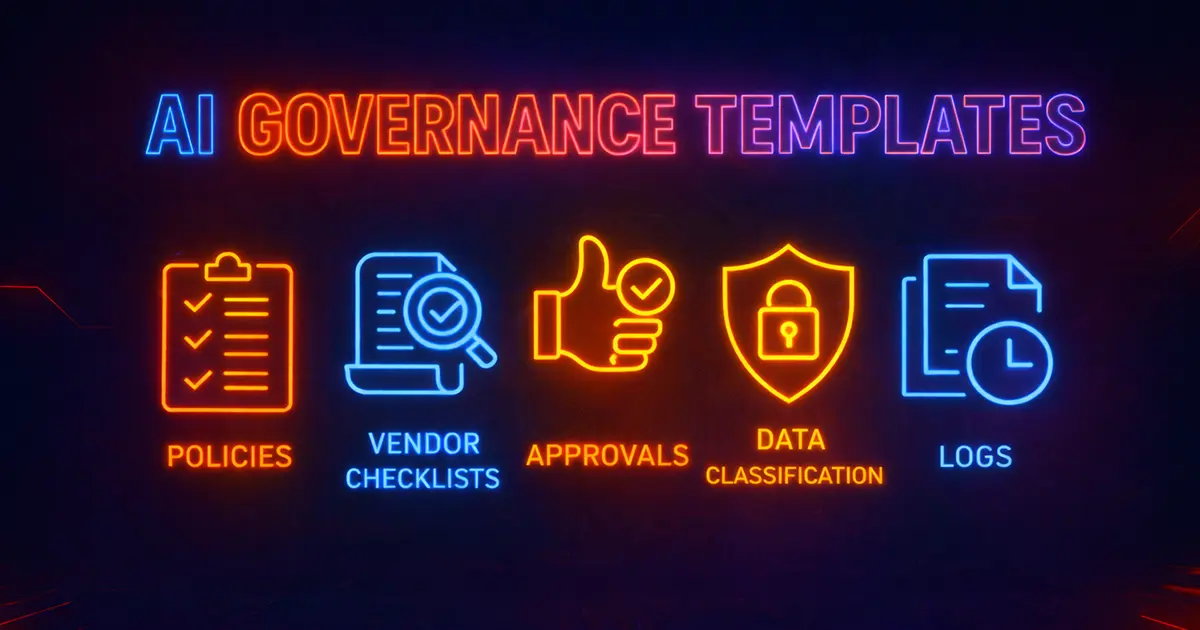
AI governance templates help you deploy AI in 2026 without chaos – clear policies, approvals, vendor checks, and data rules that keep teams productive and compliant. This page gives you copy-ready templates for SMEs and agencies: an AI use policy, data classification rules, vendor due diligence checklist, prompt + output review standards, and an incident workflow. Use these as starting points, then tailor them to your industry, risk level, and tools.
Copy-ready AI governance templates – policy, risk checks, and approvals
Quick summary
- Start simple: a 1-page AI use policy + a “never paste” data rule covers most risk fast.
- Standardize vendor review: retention, training opt-out, access controls, and incident handling.
- Use human-in-the-loop approvals for anything public, customer-facing, or compliance-related.
- Keep an audit trail: who used what tool, for what purpose, and what review happened.
Quick pick: SME starter pack (lowest friction)
Jump to the starter pack templates →Use a short AI use policy, a data classification rule, and a vendor checklist. You can deploy these in one afternoon and upgrade later.
Quick pick: privacy-first teams
Jump to privacy-first templates →If your team handles sensitive data, use stricter inputs rules, retention limits, access control, and a mandatory approval path for customer-facing outputs.
AI governance templates pack (copy and adapt)
Pick the templates that match your risk level and roll them out in order. Most teams get the biggest impact from a short “AI use policy”, a clear “never paste” rule, and a vendor review checklist.
Starter pack (SME default)
Includes: AI use policy, data classification rule, vendor checklist, approval rule, incident workflow.
- Policy: what tools are allowed and what they can be used for.
- Data rule: what must never be pasted into prompts.
- Vendor review: quick checklist before a team adopts a tool.
- Approvals: what requires a human check before sending/publishing.
- Incident: what to do if sensitive data is shared or an output causes harm.
Template 1: AI use policy (1 page)
Goal: define “allowed use”, “not allowed”, and “who approves new tools”.
- Allowed: drafting, summarizing, formatting, internal brainstorming.
- Restricted: legal advice, HR decisions, medical/financial claims, regulated outputs.
- Required: human review for public/customer-facing content.
- Escalation: how to request approval for new tools or workflows.
Copy-ready skeleton:
- Purpose: We use AI to speed up work while protecting customers, data, and brand.
- Scope: Applies to employees, contractors, and agency partners using AI for company work.
- Approved tools: Listed in the internal tool registry. New tools require vendor review approval.
- Human review: Required before publishing or sending customer-facing outputs.
- Data rules: Follow the “never paste” list and data classification policy below.
- Logging: Keep records for high-risk uses (support decisions, external comms, regulated topics).
Template 2: data classification + “never paste” rule
Goal: prevent accidental leaks and keep GDPR headaches away from day one.
- Public: safe to paste (published website content, approved marketing copy).
- Internal: okay with approved tools (SOPs, process notes, internal docs).
- Confidential: only if policy allows (contracts, pricing strategy, roadmap).
- Restricted: never paste (PII, credentials, client secrets, payment data, HR data).
Copy-ready “never paste” list:
- Passwords, API keys, tokens, private links, internal admin URLs
- Customer PII (names + identifiers), medical data, HR files
- Payment details, invoices with full customer details, bank info
- Unreleased pricing, M&A, legal disputes, sensitive contracts
Template 3: vendor due diligence checklist (fast)
Goal: approve tools based on policy, not vibes.
- Data retention: how long are prompts/outputs stored?
- Training: can you opt out of training on your data?
- Access controls: SSO, admin roles, audit logs.
- Regions: where is data processed and stored?
- Subprocessors: is there a list and change notifications?
- Security: SOC2/ISO statements, incident response process.
- Exports: can you export data and delete it?
Template 4: approvals and publishing rule
Goal: stop risky outputs from reaching customers or the public without review.
- Low risk: internal drafts, brainstorming – no approval needed.
- Medium risk: customer replies and claims – must be reviewed by a human.
- High risk: legal, HR, regulated topics – require escalation and documentation.
Copy-ready rule: “If it is public, customer-facing, or includes claims, a human approves it before it ships.”
Template 5: incident workflow (when something goes wrong)
Goal: act fast if sensitive data is shared or an output causes harm.
- Step 1: stop the workflow and revoke access if needed.
- Step 2: document what happened (who, what, when, tool, data type).
- Step 3: contact vendor support and request deletion if applicable.
- Step 4: review customer impact and notify internally.
- Step 5: update policies and prevent recurrence (training + controls).
Privacy-first pack (stricter controls)
Includes: stricter data rules, mandatory retention limits, approvals, and a tool registry.
- Use only approved vendors with documented policies and contracts where required.
- Enforce admin controls: SSO, role-based access, audit logs.
- Set short retention where possible and avoid storing prompts by default.
- Require citations and validation for decision-support use cases.
How we evaluate AI governance templates
Testing – 2026Governance only works if people actually follow it. We design templates that are short, enforceable, and easy to roll out in real teams – with a clear audit trail when needed.
Can a non-technical team understand the rules in one read?
Does this add minimal friction while reducing real risk?
Can you prove what happened if something goes wrong?
Does it map to real vendor controls like retention, roles, and logging?
Can this work for 5 people today and 50 people later?
Which template should you use – and when?
If you are unsure where to start, implement the first 3 templates this week. That alone covers most risk for SMEs in 2026.
| Template | Use it when | Owner | Minimum rollout |
|---|---|---|---|
| AI use policy | You want clear allowed vs restricted usage. | Ops / team lead | 1 page + link to data rule |
| Data classification | You handle customer data or internal secrets. | IT/Ops | “Never paste” list + quick training |
| Vendor checklist | You are adopting a new AI tool or model provider. | Ops/IT | 10 questions + approval sign-off |
| Approvals rule | You send outputs to customers or publish content. | Department lead | “Human approves before shipping” |
| Incident workflow | You want a plan for data leaks or harmful outputs. | Ops + IT | 5-step response checklist |
Tip: keep governance lightweight. Overly complex rules get ignored. Add friction only for high-risk actions.
How to roll out AI governance in 5 steps
This rollout works for most SMEs and agencies. Keep it simple, train once, then refine quarterly.
1) Pick owners
- Who approves tools?
- Who owns the policy?
2) Implement data rules
- Define “never paste”.
- Set training and retention defaults.
3) Approve tools
- Use the vendor checklist.
- Create a simple tool registry.
4) Add approvals
- Customer-facing outputs require review.
- High-risk topics require escalation.
5) Re-test quarterly
- Review tool changes and model updates.
- Update templates as workflows evolve.
Governance recipes (SME, agency, privacy-first)
Use the recipe that fits your environment. You can start with the SME recipe today, then upgrade if your risk increases.
SME recipe (fastest)
- 1-page AI use policy + “never paste” data rule.
- Vendor checklist for new tools.
- Human approval for customer-facing outputs.
Agency recipe (client safety)
- Client data separation rules and prompt hygiene.
- Approval steps before publishing or sending outputs.
- Document what tool/model produced what deliverable.
Privacy-first recipe (strict)
- Approved vendor list only + admin controls enforced.
- Short retention where possible + opt-out of training.
- Mandatory review and documentation for high-risk outputs.
Frequently Asked Questions
What is AI governance for small businesses in 2026?
AI governance is a simple set of rules that controls which AI tools are allowed, what data can be used, what requires human approval, and how you document decisions. The goal is speed with safety.
What is the fastest AI policy to implement?
Start with a 1-page AI use policy plus a clear “never paste” data rule. Add a vendor checklist for any new tools and require human review for customer-facing outputs.
Do I need legal help for AI governance templates?
These templates are starting points, not legal advice. For regulated industries or sensitive data, you may want legal review, but most SMEs can start with basic rules and tighten over time.
What data should never go into AI prompts?
Never paste passwords, API keys, customer PII, payment details, HR files, or sensitive contracts. Use data classification rules to define what is allowed.
How do I approve a new AI tool?
Use a vendor due diligence checklist: retention, training opt-out, access controls, processing regions, subprocessors, exports, and incident response. Document the decision.
How do I prevent hallucinations from harming customers?
Use strict templates, require human review for customer-facing outputs, and add guardrails like citations, structured output, and escalation rules when confidence is low.
What are the best governance controls for teams?
Role-based access, audit logs, SSO, short retention, and clear approval workflows. Pair this with AI data privacy basics and evaluations and guardrails.
How does governance relate to GDPR and the EU AI Act?
Governance helps you control personal data handling, retention, and accountability. For a practical overview, see EU AI Act compliance basics and AI data privacy 101.
Should every AI output be reviewed by a human?
No. Review only where risk is higher: public content, customer-facing responses, compliance topics, or regulated claims. Low-risk internal drafts usually do not need approval.
How often should we update our AI governance documents?
Review quarterly or when you adopt new tools, models, or workflows. Update the vendor checklist and data rules whenever policies or features change.
Final thoughts
AI governance is not about slowing teams down. It is about keeping speed sustainable. Start with a short AI use policy and a clear “never paste” rule, approve vendors with a simple checklist, and add human review where risk is higher. That is the practical governance baseline for 2026.
- Start today: 1-page policy + data rule.
- Approve tools: vendor checklist + tool registry.
- Reduce risk: approvals for customer-facing and public outputs.
Next up: map vendors and model providers on AI Platforms & Models.
AI Tools Business is independent. We test tools hands-on and publish results with citations or screenshots where relevant.
Editorial safeguards
- Claims verified by a second reviewer before publication.
- Changes and price updates are date-stamped and appended.
- We may use affiliate links - rankings are never paid.